/* ── Image Hero ── */
.ac-hero-img{position:relative;border-radius:var(--r);overflow:hidden;min-height:460px;display:flex;align-items:center;justify-content:center;margin-bottom:32px}
.ac-hbg{position:absolute;inset:0;width:100%;height:100%;object-fit:cover;z-index:0;filter:brightness(.85)}
.ac-hero-img::after{content:'';position:absolute;inset:0;background:linear-gradient(150deg,rgba(4,70,67,.93) 0%,rgba(6,85,82,.86) 40%,rgba(12,154,148,.68) 100%);z-index:1}
.ac-hi{position:relative;z-index:2;padding:56px 48px;text-align:center;color:#fff;max-width:860px;width:100%}
@media(max-width:900px){.ac-hero-img{min-height:360px}.ac-hi{padding:40px 24px}}
@media(max-width:540px){.ac-hero-img{min-height:280px}.ac-hi{padding:32px 16px}}
/* ── Split Section ── */
.ac-split{display:grid;grid-template-columns:1fr 1fr;gap:40px;align-items:center;margin-bottom:52px}
.ac-split.r .ac-si{order:2}.ac-split.r .ac-sc{order:1}
.ac-si{border-radius:var(--r);overflow:hidden;box-shadow:var(--sh)}
.ac-si img{width:100%;height:380px;object-fit:cover;display:block;transition:transform .5s ease}
.ac-si:hover img{transform:scale(1.04)}
@media(max-width:900px){.ac-split,.ac-split.r{grid-template-columns:1fr;gap:24px}
.ac-split.r .ac-si,.ac-split.r .ac-sc{order:unset}.ac-si img{height:260px}}
/* ── Doctor Cards ── */
.ac-doc-row{display:grid;grid-template-columns:repeat(auto-fit,minmax(200px,1fr));gap:20px;margin-top:24px}
.ac-doc{border-radius:var(--r);overflow:hidden;border:1.5px solid var(--line);background:var(--bg);text-align:center;transition:box-shadow .2s,transform .2s}
.ac-doc:hover{box-shadow:var(--sh);transform:translateY(-2px)}
.ac-doc img{width:100%;height:210px;object-fit:cover;object-position:top;display:block}
.ac-doc-info{padding:16px 14px 18px}
.ac-doc-n{font-weight:700;margin:0 0 3px;font-size:.95rem;color:var(--text)}
.ac-doc-r{font-size:.8rem;color:var(--muted);margin:0}
/* ── Result Banner ── */
.ac-result-img{border-radius:var(--r);overflow:hidden;margin:24px 0;position:relative;box-shadow:var(--sh)}
.ac-result-img img{width:100%;max-height:380px;object-fit:cover;display:block}
.ac-result-cap{position:absolute;bottom:0;left:0;right:0;background:linear-gradient(0deg,rgba(4,70,67,.85),transparent);color:#fff;padding:28px 24px 20px;font-size:.9rem;letter-spacing:.01em}
/* ── Small image grid ── */
.ac-img-row{display:grid;grid-template-columns:repeat(3,1fr);gap:10px;margin:20px 0}
.ac-ir{overflow:hidden;border-radius:var(--r2);aspect-ratio:4/3}
.ac-ir img{width:100%;height:100%;object-fit:cover;display:block;transition:transform .4s}
.ac-ir:hover img{transform:scale(1.05)}
@media(max-width:600px){.ac-img-row{grid-template-columns:1fr 1fr}}
/* ── Improved section spacing ── */
.ac-section{padding:52px 0}.ac-section-alt{background:var(--bg2);border-radius:var(--r);padding:44px 36px;margin:0 0 52px}
@media(max-width:540px){.ac-section-alt{padding:28px 18px}}
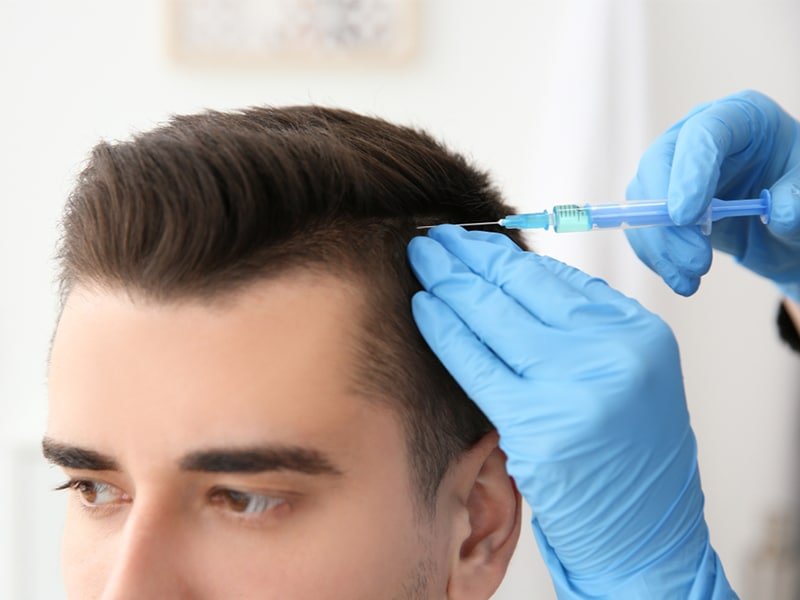
Regenerative Hair Restoration
PRP Hair Treatment in Karachi
Harness your own blood’s growth factors to reawaken dormant follicles, halt shedding, and restore natural hair density — without surgery.
Book Your PRP Consultation
45–60minPer Session
6–8Sessions Recommended
3–4Month Results Timeline
100%Natural (Your Own Blood)
Science-Backed Hair Regrowth
Why PRP Works for Hair Loss
Platelet-Rich Plasma (PRP) is derived from your own blood. After centrifugation, a concentrated serum of growth factors — PDGF, IGF, VEGF, EGF — is injected into the scalp. These proteins stimulate inactive (telogen-phase) follicles into active growth (anagen) and strengthen existing miniaturised hairs.
PRP is most effective for androgenetic alopecia (pattern hair loss), postpartum shedding, and stress-induced alopecia. It can be combined with minoxidil or finasteride for enhanced results, and with Exosome therapy for advanced cases.
Causes We Treat
Types of Hair Loss PRP Addresses
🧬
Androgenetic AlopeciaGenetic male-pattern and female-pattern hair loss — the most common cause. PRP slows miniaturisation and stimulates dormant follicles in the crown and hairline.
🤱
Postpartum Hair LossTelogen effluvium after childbirth causes dramatic shedding at 3–6 months postpartum. PRP accelerates the return to anagen phase.
😰
Stress-Induced SheddingChronic stress triggers diffuse thinning. PRP combined with scalp care protocols restores density in 3–5 months.
💊
Medication-Related LossShedding after thyroid medication, chemotherapy, or iron deficiency responds well to PRP once the underlying cause is corrected.
⭕
Alopecia Areata (Patches)PRP injections into patchy hair loss areas help in early, limited-area cases — often used alongside intralesional steroids.
🔬
Early Traction AlopeciaFollicle damage from tight styling can be halted and partially reversed with PRP if treated before permanent scarring occurs.
Step-by-Step Process
Your PRP Hair Treatment Journey
01
Consultation & TrichoscopyWe assess your scalp under dermoscopy, measure hair density, review bloods (thyroid, ferritin, DHT), and determine candidacy for PRP.
02
Blood Draw (30–40 ml)A small blood draw is taken from your arm — equivalent to a routine blood test. No anaesthesia required for this step.
03
Centrifugation & ActivationBlood is spun in a medical centrifuge to separate platelet-rich plasma. Calcium chloride is added to activate growth factor release.
04
Scalp PreparationTopical numbing cream is applied for 20 minutes to maximise comfort during the injection phase.
05
Micro-Injection into ScalpPRP is injected at 1 cm intervals across the thinning zone using a fine 30-gauge needle. Most patients describe it as mild pressure, not pain.
06
Post-Care & Follow-UpAvoid washing your hair for 24 hours. Results accumulate over 3–4 months; maintenance injections every 4–6 months sustain results long-term.
PRP Upgrades
Enhanced PRP Protocols
PRP + ExosomesOur most powerful hair restoration combination. Exosomes amplify PRP’s growth signals up to 10×, delivering measurable density gains in 8–12 weeks for advanced cases.
Advanced Protocol
PRP + MesotherapyBiotin, zinc, and DHT-blocker micro-injections are combined with PRP in a single session for comprehensive follicle nutrition and hormonal protection.
Popular Combo
PRP + MicroneedlingDermaroller creates micro-channels before PRP application, increasing serum absorption into follicular units by up to 40% compared to injection alone.
Scalp PRP (Women-Specific)Tailored concentration and injection technique for women’s diffuse thinning patterns — different from men’s recession-focused protocols.
Your Care Team
Meet Your Specialist
PRP hair treatment at Abdullah Clinics is performed by experienced trichologists and dermatologists who understand the specific hair loss patterns seen in Pakistani and South Asian women.

Dr. Bushra
Consultant Dermatologist
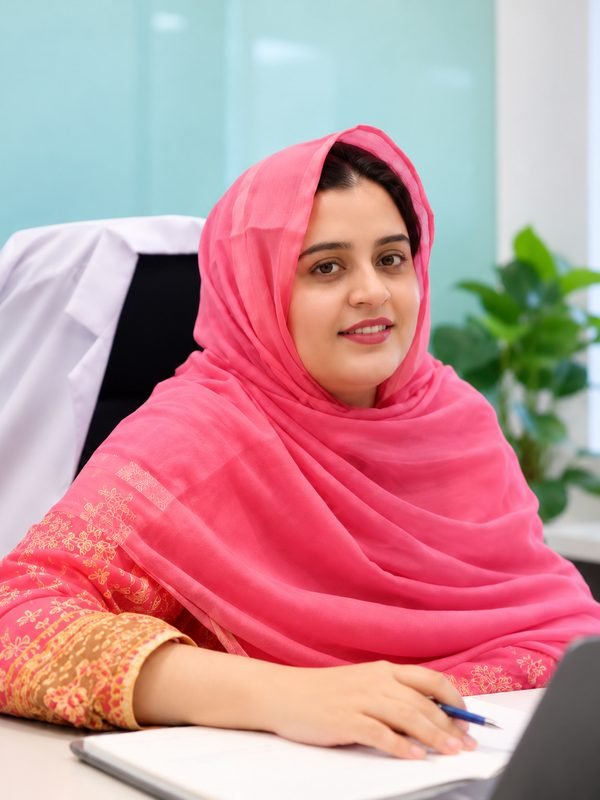
Dr. Sabahat
Skin & Aesthetics Specialist

Dr. Khaliq
Hair & Skin Consultant
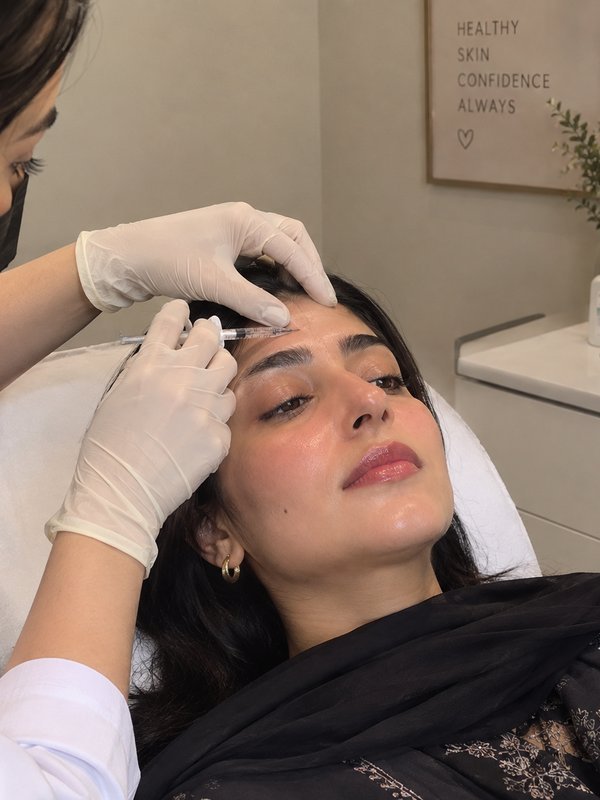
Our Clinic
Phase 6, DHA Karachi
Frequently Asked
PRP Hair Treatment FAQs
Does PRP hair treatment hurt?
We apply topical numbing cream for 20 minutes before injections, making the procedure well-tolerated for the vast majority of patients. You may feel mild pressure or a tingling sensation. Post-treatment scalp tenderness lasts 1–2 days and responds well to paracetamol.
When will I see results?
Most patients notice reduced shedding within 4–6 weeks and visible new growth by 3–4 months. Maximum density improvement is typically seen at 6 months after completing the initial course of 6–8 sessions. Patience is key — hair grows slowly.
Is PRP halal? Does it involve haram substances?
PRP is derived entirely from your own blood — no animal by-products, no porcine-derived components, and no stem cells from prohibited sources. Many Islamic scholars permit autologous (your own) blood-derived treatments when there is a medical need. We advise you to consult your own scholar if you have specific concerns.
Can I get PRP if I colour my hair?
Yes — hair dye does not affect PRP efficacy. We ask you to avoid colouring your hair 3 days before and 5 days after each session to prevent scalp irritation during the micro-injection phase.
How long do PRP results last?
Results from the initial course typically last 12–18 months. Maintenance sessions every 4–6 months are recommended to sustain density. Without maintenance, shedding may gradually return — PRP manages hair loss rather than permanently curing the underlying cause.
Am I a candidate if I have completely bald patches?
PRP works best when follicles are dormant but alive — it cannot regenerate follicles that have been permanently destroyed. If your bald patches have been present for more than 5 years and trichoscopy shows fibrosis, a hair transplant consultation is more appropriate. We’ll advise you honestly at your assessment.
Take Back Your Hair Density
Book your PRP hair treatment consultation at Abdullah Clinics, Phase 6, DHA Karachi — where every treatment is supervised by a qualified dermatologist.
Book Consultation