
FUE Hair Transplant in Karachi
FUE hair transplant in Karachi moves individual hair follicles from the back and sides of your scalp to thinning areas, one unit at a time. At Abdullah Clinics, a doctor examines your donor area in person before any graft number or price is discussed. Part of our hair transplant in Karachi guide.
Medically reviewed by Dr. Bushra Paracha, Consultant Dermatologist & Hair Transplant Surgeon
FUE hair transplant in short
FUE (follicular unit excision, also called follicular unit extraction) takes small groups of one to four hairs from the back and sides of the scalp and places them into thinning areas. It leaves tiny dot scars instead of a linear scar, and the donor area is usually shaved. Your donor area decides what is possible, so a graft number or package price means little before a doctor has examined you. Visible growth takes months, and the full result often takes a year or more. Your doctor chooses between FUE, FUT and other options, and results vary.
What is an FUE hair transplant?
Hair transplants move hair from a donor area, usually the back and sides of the scalp, to areas that are thinning or bald. Donor hair is generally more resistant to the hormone effects behind pattern hair loss, which is why it can keep growing after it is moved.
In FUE the surgeon extracts single follicular units, the natural groups of one to four hairs, with a very small punch under local anaesthetic. The International Society of Hair Restoration Surgery (ISHRS) describes these punches as roughly 0.7 to 1.2 mm wide. Each unit is then placed into the recipient area at an angle and direction that matches your own hair.
Because no strip of scalp is removed, FUE leaves no linear scar. It does leave many tiny dot scars in the donor area, and the donor area is usually shaved. Your hair supply is limited over a lifetime, so planning matters as much as technique.
Who is a good candidate for FUE?
A good plan starts with your donor hair, your pattern of loss and your goals. These are the situations where doctors most often consider FUE. Try the HairScore quiz for an early idea of your stage.
Healthy donor hair
Good density at the back and sides gives the surgeon enough hair to work with.
Hair loss that has settled
ISHRS describes ideal candidates as having stabilised loss. Your doctor assesses this.
Short or tied back hairstyles
With no linear scar, FUE suits people who wear their hair short.
Receding hairline and temples
A common reason people ask about FUE in Karachi.
Thinning on the crown or mid scalp
Density can be added within the limits of the donor supply.
Realistic goals
A doctor will tell you honestly what is achievable.
Your donor area decides the plan, and the hairline is designed for the long term
Many people arrive in Karachi asking how many grafts they need. The more useful question is whether your donor density and pattern of loss make FUE the right choice. Your donor hair is limited over a lifetime, and poor planning today can reduce your options later.
A proper consultation covers donor density, hair calibre, the stage and likely progression of your hair loss, scalp condition, age, medical history and your expectations. A graft number quoted without this can mislead.
A natural hairline suits your face, your age and your existing hair, and leaves enough donor hair for the years ahead. At Abdullah Clinics, hairline design is planned with long term progression in mind, and a conservative plan can protect your options if hair loss continues.
How an FUE hair transplant in Karachi works, step by step
Consultation and scalp assessment
The doctor examines your donor density, hair calibre, scalp condition and pattern of loss, and reviews your medical history and medicines. There is no obligation to proceed.
Graft plan and hairline design
Your doctor explains a realistic graft range, the limits of your donor area and a hairline that suits your face. You agree the plan before surgery day.
Preparation
You receive written instructions beforehand. On the day the donor area is prepared, which usually means shaving, and the scalp is numbed with local anaesthetic.
Extraction
Individual follicular units are taken one by one from the donor zone and kept moist and protected until placement.
Placing the grafts
Small recipient sites are created and the grafts are placed at a natural angle and direction in the thinning area.
Aftercare and review
You go home with clear written aftercare advice on washing, sleeping and sun protection, and review visits are planned with the team.
FUE hair transplant results: the month by month timeline
- Day 0 to 3
Soreness, tightness and swelling of the forehead or scalp are common. Small scabs form at each graft site.
- Week 1 to 2
Scabs usually come off within one to two weeks, though this varies from person to person. Follow your washing instructions exactly.
- Week 2 to 8
Transplanted hairs commonly shed, leaving the area looking bare. The roots stay in place and are expected to regrow. Some existing hairs may also shed for a time.
- Month 3 to 4
Fine new hairs begin to appear, often thin and uneven at first.
- Month 6 to 9
Hairs thicken and density becomes easier to judge. Styling is usually possible by this stage.
- Month 12 and beyond
ISHRS notes that the full result often takes a year or more. Hair grows at roughly the usual pace, about 1 cm a month.
Individual results vary. No clinic can promise a specific number of hairs, a particular density or the same result as another patient.
What does the evidence say about FUE?
A 2026 narrative review in Frontiers in Medicine covered complications after FUE. It reported that large series show overall complication rates of roughly 1.2 to 4.7 percent, and that most events were mild and settled by themselves. Overharvesting was named as a key concern, especially in very large sessions. The authors noted that incidence figures are approximate and prospective studies are needed.
A 2025 narrative review of FUE devices in the Journal of Cutaneous and Aesthetic Surgery described manual, motorised and robotic systems. It found that many performance claims came from manufacturers or the authors' own experience, and that no pooled outcome data were reported. The ISHRS patient guide adds that FUE is not scarless and warns about unlicensed technicians.
What this means for you: FUE is an established option with mostly mild, short lived side effects when planned well. The evidence is mainly narrative reviews and surgical experience, so the surgeon's training, the donor plan and an honest talk about limits matter more than any device name.
FUE side effects and who should wait
Usually expected, short lived effects
- Soreness, tightness and small scabs in the first days
- Swelling of the forehead, sometimes around the eyes
- Temporary shedding of transplanted hairs, then regrowth
- Small pale dots in the donor area
- Redness or small pimples at graft sites
Less common risks include folliculitis, infection, scalp cysts, poor growth of some grafts and a patchy donor area if too much hair is taken. Tell your doctor if you smoke, as reviews link smoking with poorer growth.
Call us, and who should wait
- Call the clinic if pain increases, redness spreads, pus appears or you develop a fever
- Seek urgent care for bleeding that continues after firm pressure, or swelling with eye pain or vision changes
- Tell your doctor about blood thinners, bleeding problems, diabetes or other health conditions
- Surgery may wait if you have an active scalp infection or inflammatory scalp disease
- Very thin donor hair or rapidly changing hair loss may mean surgery is not advised yet
FUE vs FUT vs DHI: how the options compare
FUE vs FUT comes down to scars, hair length and graft numbers. FUE vs DHI comes down to how grafts are placed, and Abdullah Clinics offers both FUE and DHI. Two non surgical options are added for context.
| Option | How it works | Scar pattern | Often suits |
|---|---|---|---|
| FUE | Follicular units are extracted one by one and placed into recipient sites | Many tiny dot scars | Shorter hairstyles, no linear scar, moderate graft plans |
| FUT | A thin strip is removed and dissected into grafts | One thin linear scar | Large sessions, hair worn longer, limited donor area |
| DHI | Grafts are usually taken as in FUE and placed with an implanter pen | Many tiny dot scars | Patients whose doctor recommends implanter placement |
| PRP for hair | No grafts, platelet rich plasma is injected into the scalp | None | Early thinning, or support alongside surgery |
| Alopecia treatment | Medical assessment and treatment of the cause | None | Patchy or inflammatory hair loss |
Unsure? Read PRP vs hair transplant, see the main hair transplant in Karachi page, or take the HairScore quiz.
FUE hair transplant cost in Karachi
There is no single FUE price, because two patients rarely need the same plan. Abdullah Clinics gives a clear written price after a doctor has examined your scalp, so you know what is included before you commit. Our hair transplant cost in Karachi guide covers pricing more widely. The main drivers are below.
Number of grafts
A larger plan needs more extraction and placement time.
Area to cover
A hairline, a crown and a full top of the head are different amounts of work.
Donor area and technique
Your donor density, hair type and whether FUE or DHI placement is planned shape the work involved.
Doctor and team time
Planning, extraction, placement and review visits all need skilled time.
Clinics price in different ways, such as per graft or by a graft range. Ask any clinic offering FUE hair transplant in Pakistan for a written quote that lists what is included, who performs each step and what follow up is covered. The ISHRS warns that very cheap offers may involve unlicensed technicians, which can damage the donor area.
Hair transplant doctors in Karachi at Abdullah Clinics
Every plan begins with an in person assessment. Your doctor examines your scalp and sets out the options with you. All our doctors see patients at both branches.
Dr. Bushra Paracha
Consultant dermatologist, aesthetic physician and hair transplant surgeon at Abdullah Clinics.
Dr. Sabahat
Consultant dermatologist, aesthetic physician and hair transplant surgeon at Abdullah Clinics.
Dr. Abdul Khaliq
Aesthetic physician and hair transplant surgeon at Abdullah Clinics.
Read more about the team on the about page.
FUE hair transplant for patients across Karachi
Abdullah Clinics has two branches in Karachi: the Tariq Road clinic on Allama Iqbal Road in PECHS Block 2, and a branch at 4th Floor, 130-C Main Korangi Rd, near Masjid-e-Tooba, D.H.A. Phase 1 Commercial Area B. All our doctors see patients at both branches. Patients who ask about FUE hair transplant come from across the city, including DHA, Clifton, Gulshan e Iqbal, Gulistan e Johar, North Nazimabad, Saddar and PECHS.
Visits are by appointment. Message us on WhatsApp on 0333 358 8706 (Tariq Road) or message the DHA Phase 1 branch on 0301 9284080, and we will confirm a time that suits you. If you live in another city, you can send clear photos on WhatsApp for an initial opinion before you travel.
Planning from another part of Karachi? See our pages for hair transplant in DHA and Clifton, hair transplant in PECHS, Tariq Road and Saddar and hair transplant in Gulshan, Johar and North Nazimabad.
Why choose Abdullah Clinics for FUE hair transplant in Karachi
Consultation first
A doctor examines your donor area and explains what FUE can and cannot do for you, with no obligation to proceed.
Donor area before package
Your graft plan follows your donor density and goals, and not a fixed package.
Honest about options
We explain FUE, FUT and DHI openly and point you to the one that suits your scalp.
Clear pricing
You receive a written price after assessment.
Questions every Karachi patient should ask a hair transplant clinic
Whichever clinic you choose, these questions help you compare plans fairly. We are happy to answer them at your consultation.
Who plans it
Who personally evaluates my donor area and designs the hairline?
The graft number
How is the suggested graft range calculated, and what does it include?
Realistic outcome
What result is realistic for my specific pattern and stage of loss?
On the day
Who is directly involved in the extraction and implantation?
After surgery
What follow up and aftercare are included?
The future
What happens if my non transplanted hair continues to thin over time?
How to care for your scalp after FUE
Do
- Follow your doctor's written washing and sleeping instructions
- Protect the scalp from the strong Karachi sun while it heals
- Attend your review visits and ask questions early
Avoid until your doctor says it is safe
- Prolonged sun exposure during the healing phase
- Strenuous exercise and heavy lifting
- Picking at scabs or rubbing the recipient area
Aftercare guidance is part of the treatment. Contact the clinic if you develop increasing pain, spreading redness, pus or fever.
FUE hair transplant in Karachi: frequently asked questions
What is an FUE hair transplant?
FUE stands for follicular unit excision, also called follicular unit extraction. Individual groups of one to four hairs are taken one at a time from the back and sides of the scalp with a tiny punch, then placed into thinning areas. No strip of scalp is removed, so there is no linear scar. A doctor confirms suitability.
How do I know if an FUE hair transplant in Karachi is right for me?
A doctor has to examine your scalp in person, because the answer depends on your donor density, hair calibre, stage of hair loss and how stable it is. FUE tends to suit healthy donor hair, realistic goals and settled hair loss. Younger patients are often advised to wait.
How much does FUE hair transplant cost in Karachi?
The cost depends on the number of grafts, the area to be covered, your donor area and the doctor and team time needed. Abdullah Clinics gives a clear written price after a doctor has assessed your scalp, so you know what is included before you decide. Read our hair transplant cost in Karachi guide, or message us on WhatsApp on 0333 358 8706.
Karachi mein FUE hair transplant ka tareeqa kya hai? (What is the FUE hair transplant procedure in Karachi?)
The doctor first assesses your donor area and designs the hairline with you. After local anaesthetic, individual follicular units are extracted from the donor zone and placed into the thinning area at a natural angle. You then receive written aftercare advice and review visits.
FUE vs FUT: which should I choose?
The choice depends on how many grafts you need, how short you will wear your hair and how you feel about scars. FUE leaves tiny dot scars and the donor area is usually shaved. FUT leaves one linear scar but needs no wide shave.
FUE vs DHI: what is the difference?
Both usually collect individual follicular units in the same way. The difference is placement: with FUE the surgeon typically makes small recipient sites and then places each graft, while DHI uses an implanter pen to place grafts. Direct comparisons are limited, so the choice rests on your plan.
What are realistic FUE hair transplant results, and when will I see them?
Results build slowly. Transplanted hairs usually shed in the first weeks, new hairs begin to appear around months three to four, and the full result often takes a year or more. No clinic can promise a specific number of hairs or outcome.
Is FUE hair transplant painful, and what is recovery like?
The scalp is numbed with local anaesthetic, so you feel pressure rather than sharp pain during surgery. Afterwards, soreness, swelling and small scabs are common. Scabs usually come off within one to two weeks, though this varies. Your doctor advises when you can return to work.
Will FUE leave scars?
FUE leaves many tiny round marks in the donor area, usually pale dots that are hard to see when hair is kept at a moderate length. It leaves no linear scar, although it is not scarless. Overharvesting can make the donor area look thin, so a conservative plan matters.
How many grafts can I have in one FUE session?
The safe number depends on your donor density, the area to cover and your long term plan, and a doctor decides it only after examining you. Reviews describe overharvesting as a key concern, particularly in very large sessions. A staged plan can protect your future options.
Who is not a good candidate for FUE?
FUE is usually not advised if your donor hair is thin or diffusely miniaturised, your hair loss is still changing quickly, you have an active scalp condition, or your expectations are not realistic. Your doctor may suggest medical treatment or PRP for hair instead.
Where can I find an FUE hair transplant clinic near me in Karachi?
Abdullah Clinics has a Tariq Road clinic in PECHS Block 2 and a branch in DHA Phase 1. Both are open Monday to Saturday, 12 PM to 8 PM, and you should confirm before visiting. Message 0333 358 8706 on WhatsApp, or call 0301 9284080 for DHA Phase 1.
Sources and medical information
- FUE Hair Transplant: Benefits, Process and Recovery, International Society of Hair Restoration Surgery (patient guide).
- Guide to FUT Hair Transplant: Benefits, Procedure and Recovery, International Society of Hair Restoration Surgery (includes FUE vs FUT comparison).
- Complications in follicular unit excision hair transplantation: current evidence and practical approaches, Frontiers in Medicine, 2026.
- A comprehensive review of evolution of advanced follicular unit excision systems, Journal of Cutaneous and Aesthetic Surgery, 2025.
This page is general information and does not replace a medical consultation. Suitability, plan and risks are confirmed by your doctor after assessment. Last updated October 2026.
Not sure which option suits you? Compare every treatment in our guide to the best hair treatment in Karachi.
Looking for a cause led plan? Read our guide to hair loss solutions in Karachi.
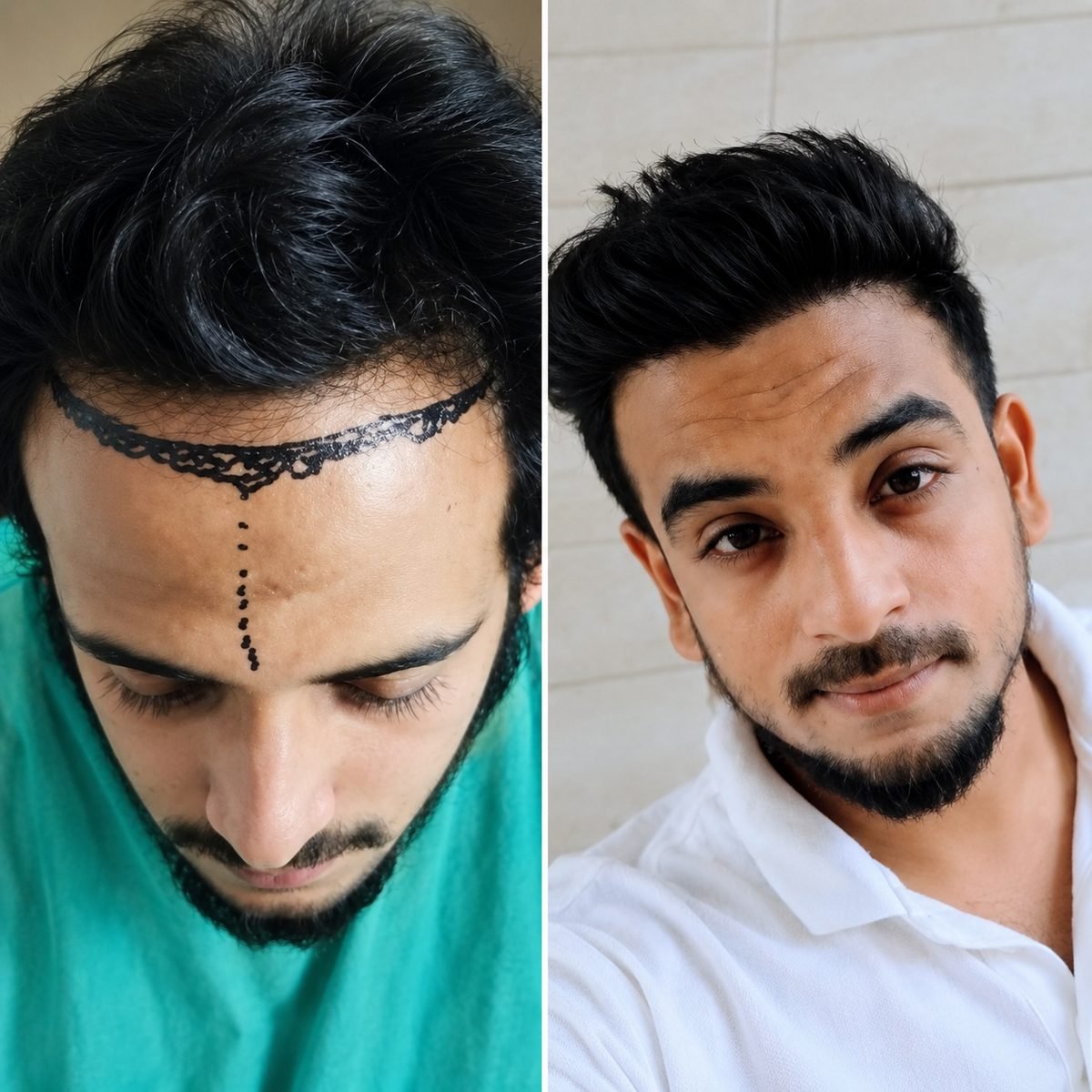
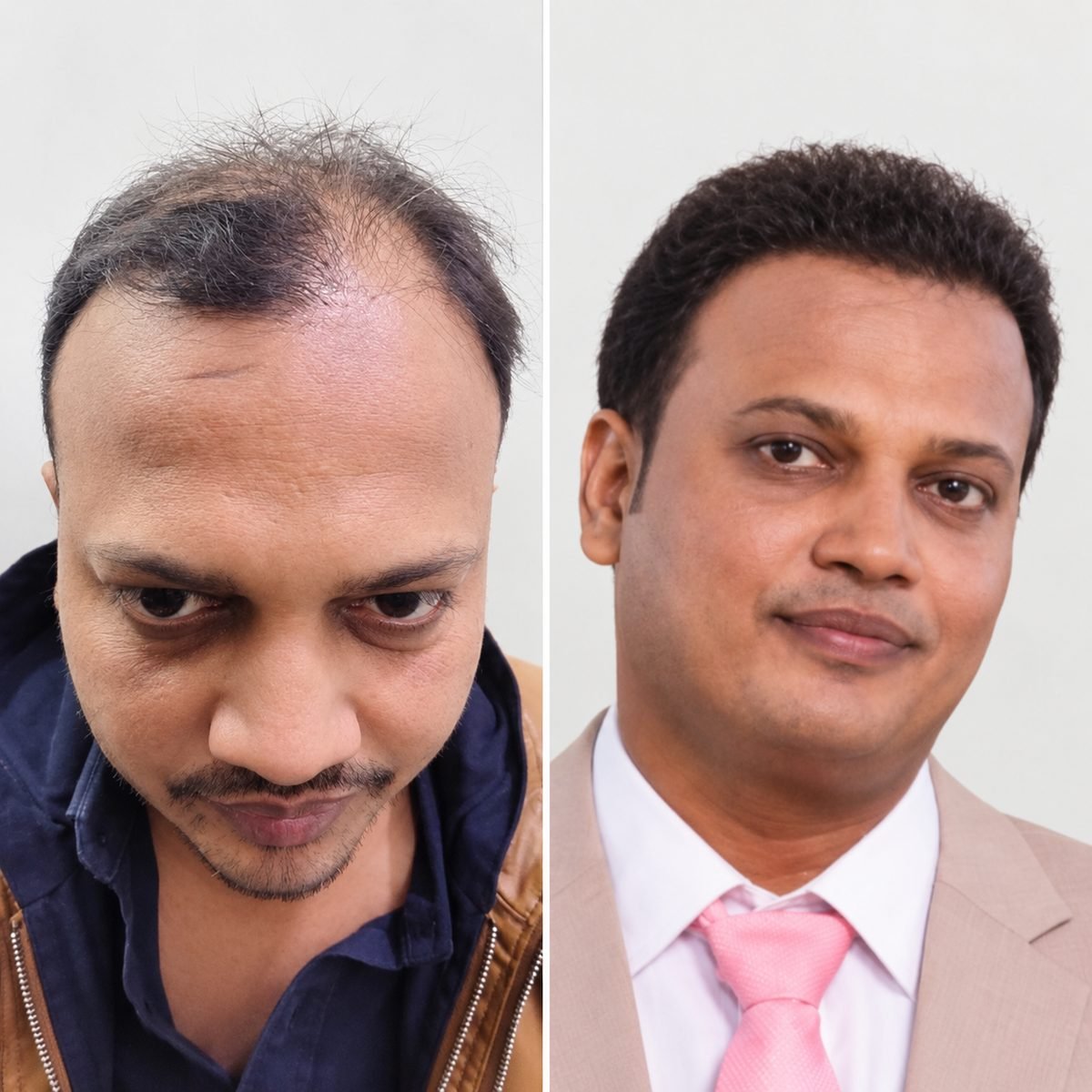
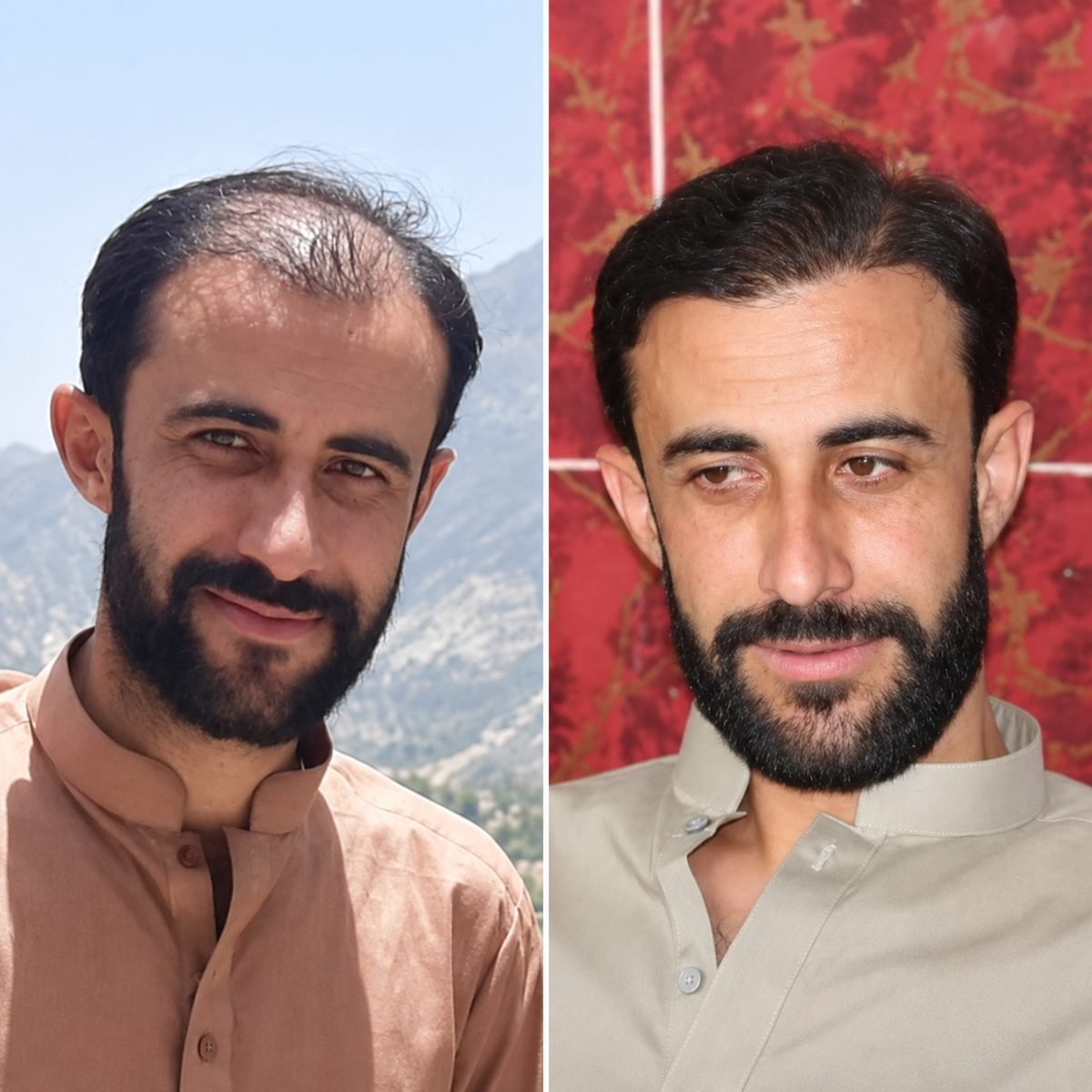
Hair transplant results at Abdullah Clinics
Real patient photographs from our Karachi clinic. Results vary from person to person and depend on donor area, hair type, graft count and your goals. See more on our hair transplant results page, or estimate your grafts.
Still comparing? Read exosomes vs PRP vs hair transplant in Karachi.
Need a diagnosis first? Book with a hair specialist doctor in Karachi.
Ready to talk about FUE hair transplant?
Book a consultation at Abdullah Clinics. A doctor will examine your donor area, explain FUE, FUT and DHI honestly and give you a written price.